

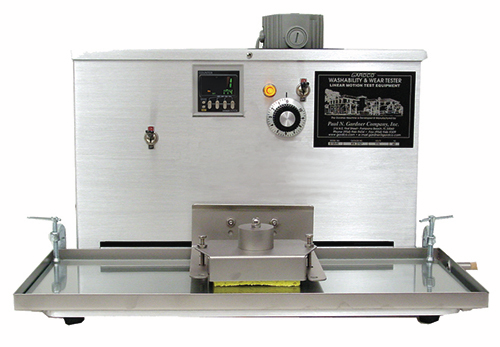
Washability Scrub Tester
Washability Scrub Tester D10V Var 10"
- Variable Speed 10" Model D10V
- Same features as the set speed models, plus variable speed, which allows accelerated testing.
- Each model has its own stroke length for its particular application. The stroke length is centered and shortened from both sides.
- Rate limits shown for all variable cycle rate (cyc/min) machines are factory set, but may be shifted for specific requirements. Instructions for this change are furnished with the unit.
Select your Model
Enter a value between 1 and 100000000 in increments of 1.
excl. taxes & shipping cost
All testing with this type of equipment involves moving one surface with respect to another under controlled conditions and determining any resulting change or interaction between the surfaces. This line of washability machines spans the range from the simple to sophisticated providing force recording of test motion resistance, which has the potential of eliminating subjective operator evaluations by quantifying many types.
- The base of all models is 0.25 inch thick aluminum plate. It is 16" deep for all models, 16" long for all D10 Models and 22" long for all other models. One-half of the depth of the machine supports all functional mechanisms and their housing. The front half of the base provides the working surface or area for product testing. The base is supported on one-half inch high feet to provide clearance for clamping test products at both ends and along the entire front edge of the base. Net Weight: (Approx. 40-50 pounds)
- The desired number of cycles is set by hand simply by pressing the Up/Down key to the desired increment for each digit, a maximum setting of 9,999 can be achieved. On start of operation, the dial counts to the preset value and turns off the machine. The counter then may be manually reset to run the same count or the count may be changed.
- All functional elements are mounted above the normal level for product testing and therefore are not subject to damage by accidental liquid spills.
- Heavy gage brushed aluminum houses all functional components with only the drive fork bracket extending forward to carry the drive fork over the test area.
- The drive fork is fabricated from 1/16" stainless steel. It is held in place by a bracket of the same material which is secured to linear bearings carried on accurately spaced parallel bars. Reciprocation of the drive fork assembly on the parallel bars is by a unique double chain and sprocket arrangement. Up to 25 lbs (11kg) load can be applied to the drive fork at one time. There are no belts, cables, springs or other such mechanisms in the drive chain requiring service or maintenance. The drive fork is adjustable vertically with respect to its drive bracket. In its lowermost position it is less than one-half inch above the test surface with the tray and glass plate in place. This relative low position minimizes the tendency of the carried surface to tilt in the direction of travel. The fork can be raised in half inch steps, inverted and further raised to accommodate test specimens up to two and a half inches thick without losing close proximity to the test surface.
- Access to the component area is by removal of only two screws from the lid of the housing.
- All controls and indicators are mounted on the front surface of this housing. The housing is eight inches high on fixed speed models and ten inches high on variable speed models.
- Absolute linearity is obtained with unique drive system. Acceleration and deceleration is sinusoidal providing for the smoothest possible change in direction at the end of each stroke.
- Design of the drive fork cradles accessories used in the test and permits them to simply be lifted free. There are, therefore, no rotational or other unbalancing forces imposed on such auxiliaries. They are "Free Floating" and self-leveling. There are three equally spaced holes in each of the tines of the drive fork. A test auxiliary can be placed in either of the three pairs of holes to accommodate positioning of the test specimen. The spacing also permits simultaneous cradling of three brush boxes, two abrasion boats or two sponge boxes for multiple specimen testing. Velocity of the drive fork is a function of stroke length as well as cycle rate.
- Electric drives used in fixed speed models are right angle gearhead motors are totally enclosed, non-ventilated permanent split capacitor type. These ball bearing motors are rated for 115 volts, 60/50 Hz, continuous duty with a temperature rise of 40°C (104°F). (Machine cycle rate is based on 60 Hz operation.) The gear case is zinc alloy, grease filled, hardened steel worm with phenolic output gear and ball bearing output shaft. Electric drives used in variable speed models are right handle gearhead motors of totally enclosed non-ventilated 90 volt permanent magnet type. These ball bearing motors are rated for continuous duty with a maximum temperature rise of 40°C (104°F). The 115 volt motor speed controller is solid state, with constant torque speed regulation and a motor speed range of 10/1. The motor gear case is die cast aluminum, oil filled with hardened steel worm and bronze output gear.
- The digital cycle counter is electrical and is energized through a switch from the drive linkage.
- All electrical components of single rate model are fused for 2 amps while all variable rate model are fused for 3 amps. The fuse holder is located on the right side of the housing. An electrical diagram is located under the lid of each machine.
- The motor speed control unit installed in all variable cycle rate models has a rated range of 10:1. Factory setting of both high and low limits are shown under "Characteristics" for each model. Internal adjustments permit changing these limits. There is interaction between these adjustments. Changing one will affect the other. The procedure for this rate limit change is furnished with operating instructions for each variable cycle rate unit.
- Applications Include: Adhesives, Anodic Coatings, Carpeting, Cement, Ceramics, Coated Paper, Coated Plastics, Coatings, Industrial, Coatings, "Slip-Proof", Concrete, Fiberglas, Floor Coverings, Foils and Films, Glass, Lacquers, Leather, Linoleum, Marble, Metals, Paints (Architectural/Traffic), Paper, Paper Board, Plastics, Plating, Rubber, Textiles, Tile, Upholstery, Varnishes, Vinyls, Waxes, Wood, Etc.
| Technical Specifications | |||||||||||||||||||||||||||||||||||||||||||||||||||||||||||||||||||||||||||||||||||||
|---|---|---|---|---|---|---|---|---|---|---|---|---|---|---|---|---|---|---|---|---|---|---|---|---|---|---|---|---|---|---|---|---|---|---|---|---|---|---|---|---|---|---|---|---|---|---|---|---|---|---|---|---|---|---|---|---|---|---|---|---|---|---|---|---|---|---|---|---|---|---|---|---|---|---|---|---|---|---|---|---|---|---|---|---|---|
| Stroke Length | 10" | ||||||||||||||||||||||||||||||||||||||||||||||||||||||||||||||||||||||||||||||||||||
| General | |||||||||||||||||||||||||||||||||||||||||||||||||||||||||||||||||||||||||||||||||||||
| Model | |||||||||||||||||||||||||||||||||||||||||||||||||||||||||||||||||||||||||||||||||||||
| Technical Data Chart | |||||||||||||||||||||||||||||||||||||||||||||||||||||||||||||||||||||||||||||||||||||
| Data |
| ||||||||||||||||||||||||||||||||||||||||||||||||||||||||||||||||||||||||||||||||||||
Manuals
- Washability-Scrub-Tester-Model-V-Manual.pdf
Washability-Scrub-Tester-Model-V-Manual.pdf

Sponge, polyurethane (pack of 6)
Article No: 5071

Leneta P121-10N Black Scrub Panel 100/pk
Article No: 12779

Leneta 123-10N White Scrub Panel 100/pk
Article No: 12781

ASTM D2486 Standard Test Kit
Article No: 13904

ASTM D4828 Standard Test Kit
Article No: 13905

ASTM D3450 Standard Test Kit
Article No: 13906

Voltage Transformer
Article No: 13916

Standard Drive Fork Replacemnt
Article No: 13917
Extended Drive Fork
Article No: 13918

Test Sample Tray, 8 x 18 x .63”
Article No: 13919
Test Sample Tray, 8 x 24 x .63”
Article No: 13920

Brush Box High Center of Gravity
Article No: 13921

Brush Box Low Center of Gravity
Article No: 13923

Scotch-Brite Ultra Fine Pads 7448
Article No: 13926

Sponge Box
Article No: 13927

Sponge ASTM D3450
Article No: 13930

Abrasion Boat
Article No: 13931

1 lb Friction Weight
Article No: 13934

Brass Shims ASTM D2486 2/pk
Article No: 13936

Lilly Type Frame Std W/Gasket
Article No: 13937
Lilly Type Frame Long W/Gasket
Article No: 13939

Glass Plate Std Stroke
Article No: 13940
Glass Plate Long Stroke
Article No: 13941

Nylon Bristle Brush, ASTM, 13 Rows
Article No: 13942
Hog Hair Bristle Brush, 13 Rows
Article No: 13951
Nylon Bristle Brush, 12 Rows
Article No: 13952
Hog Hair Bristle Brush, 12 Rows
Article No: 13953

Replacement Weight Shim for PVC Brush
Article No: 13954

Sponge Box Weight, 1500g
Article No: 13956
Sponge ASTM D3450, 1500g
Article No: 13957

Sponge Box Weight, 1000g
Article No: 13958

Sponge Box Tare Weight, 2lb
Article No: 13959

Scrub Medium Non-Abrasive 1 Pint
Article No: 13972

Scrub Medium Abrasive 1 Pint
Article No: 13973

EPA Protocol 1-1A Abrasion Accessory Package
Article No: 15295

EPA Efficacy Antimicrobial Sponge Method
Article No: 15296

SS Tray for EPA Method MB-40-00
Article No: 15365

Washability Scrub Tester D12V 12" Cut
Article No: 13910

Washability Scrub Tester D10VF10"
Article No: 13908

Washability Scrub Tester D16 Basic 16”
Article No: 13912
