
/assets%2FMultimedia%2FGARDCO%2FAssets%2FImages%2FProduct%20Images%2FDrawdown%20Charts%2Fpc%2Fhidpwr_skintone_wallmatte%2Fhidingpower.png

Practical Hiding Power Paint Chart

Art. No.: 12766

Leneta CU-1M Hiding Power Chart 100/pk

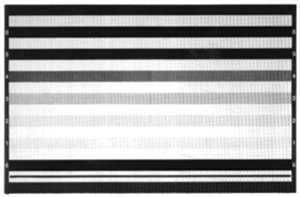
The Practical Hiding Power Paint Chart, Form CU-1M, is a sealed test chart with a series of stripes ranging from light to dark gray and black. The reflectance values of the gray shades are selected with the objective that their color differences (vs the white surround) will be in the geometric sequence: 2, 4, 8, 16, 32, and 64 CIELAB units. 

Select your Model

$782.00

Enter a value between 1 and 100000000 in increments of 1.

excl. taxes & shipping cost

The test area consists of the entire chart less the narrow gray borders with numbers. Full details with regard to reflectances and tolerances are tabulated in ASTM D5150.

Practical application tools for architectural coatings, such as paint rollers and brushes, typically apply films that vary in thickness due to incomplete leveling. Thus the effective one coat hiding power of most architectural paints is considerably less than that determined by customary laboratory procedures, which generally call for uniform films applied with a blade applicator.

Technical Data Chart
Data
Test AreaOverall SizeThickness
6 sq. ft.24" x 37.25"11.5 mils
5574 cm2610 x 946 mm0.3 mm
ASTM
D5150
Leneta CU-1M Hiding Power Chart 100/pk

  1. Determine the density of the coating in g/mL or lb/gal (note: g/mL = lb/U.S. gal ÷ 8.345)
  2. Place the chart against a smooth vertical surface, with its long edges horizontal, and tape it firmly in that position along the vertical edges leaving the numbers visible.
  3. Apply the paint uniformly over the entire test area with a 3 inch (75mm) roller or paint brush at either a “natural” or a specified spreading rate, determining the amount of paint applied by weight loss of the container plus applicator.
  4. Calculate or control the spreading rate in accordance with one of the following equations: Weight (grams) x Spreading Rate (m2/L) = 557.4 x Density (g/mL) Weight (grams) x Spreading Rate (ft2/gal) = 2721.6 x Density (lb/gal)
  5. After the paint-out has dried, record the number of the darkest stripe for which the contrast is sufficiently low to be considered as “just visible”, or “decoratively acceptable”. That number is the practical hiding power rating. In case of uncertainty between two adjacent stripes, report an intermediate fractional number.

The procedure described in ASTM Method D5150 is somewhat different than the above, having been designed specifically for roller application tests performed in a specialized manner.