

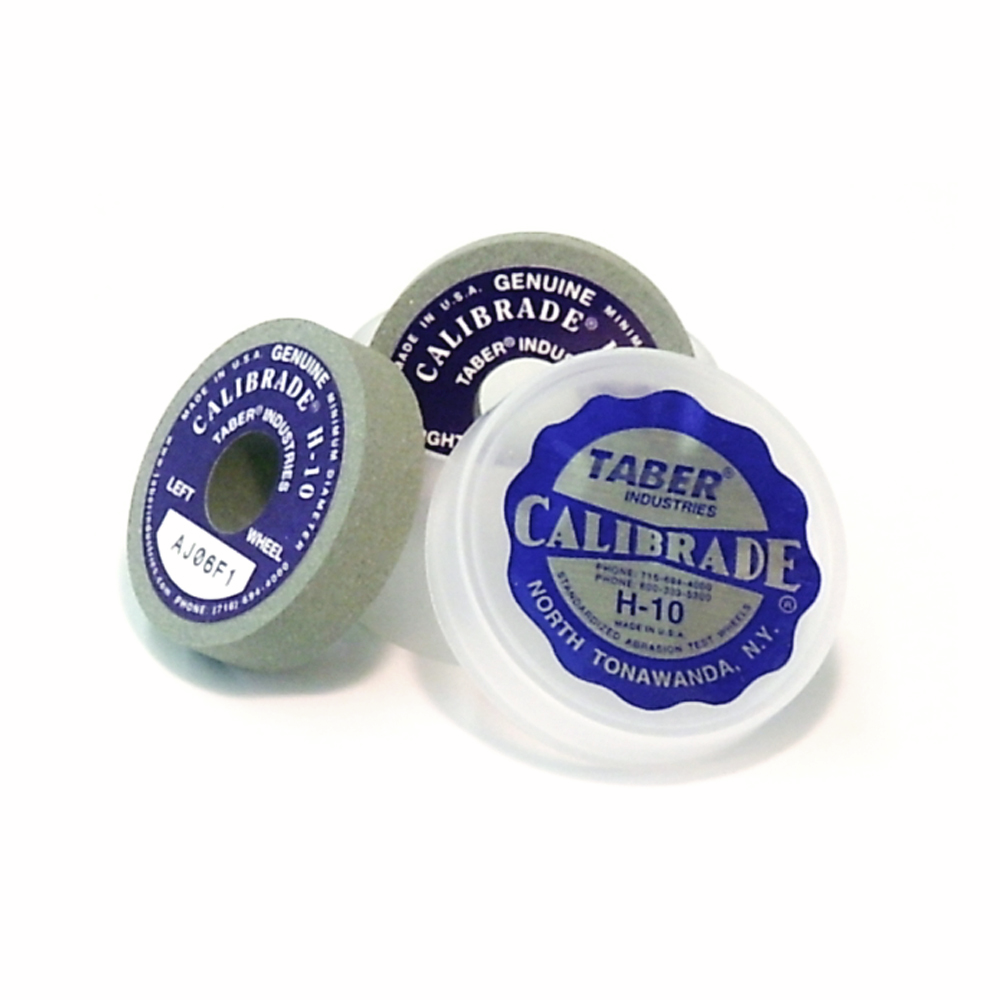
Taber Abrading Wheels
Art. No.: 10107
Taber H-10 Calibrade Wheels
- A non-resilient, vitrified wheel designed to evaluate steel and ferrous alloys for resistance to abrasion.
- It has also been used to test the effect of hardening and tempering treatment on steel and other ferrous materials.
- The H-10 vitrified wheel produces harsh abrasive action.
Select your Model
Enter a value between 1 and 100000000 in increments of 1.
excl. taxes & shipping cost
- Standardized grades of abrasive wheels, engineered for a variety of specific applications essential for conducting "TABER wear tests"
- Developed and designed by TABER Industries so the binder material breaks down during use, exposing and creating a new abrading surface
- Sold in pairs and labeled "LEFT WHEEL (or RIGHT WHEEL)" to assure that the mounting position will be duplicated after the wheels have been removed and later re-installed and shipped in tight-lidded containers to prevent damage
- The minimum usable diameter of TABER abrading wheels is 44.4 mm, which corresponds with the wheel label
- Abrading wheels for the Taber Abraser (The label is also used to indicate the minimum diameter of the wheels (1.75 inch or 44.45 mm OD). When the wheel is worn to the label, it must be replaced):
- Calibrase® - A resilient wheel composed of resilient binder and aluminum oxide or silicon carbide abrasive particles. Frequently used to evaluate rigid specimens. WARNING: Because of possible deterioration, Calibrase wheels should NOT be used after the expiration date printed on the wheel.
- Calibrade® - A non-resilient wheel composed of a vitrified (clay) binder and silicon carbide or aluminum oxide abrasive particles. Frequently used to evaluate flexible specimens. NOTE: Calibrade wheels do not have an expiration period.
- Sandpaper Strips - Include a pressure sensitive adhesive to attach the strip to the periphery of CS-0 (S-32) resilient wheels. The paper is an "A" weight which satisfies the paper grammage requirement of 70 - 100 g/m². To maintain the rate of abrasion, the sandpaper strips must be changed after a defined number of test cycles (typically 200 or 500).
- Depending on the abradant type and test specimen, the wheel surface may change (i.e. become clogged) due to the transfer of material from the test specimen to the abrading wheel, and must be cleaned at frequent intervals. How long a set of Genuine Taber Wheels will last is dependent on the load, surface texture and frictional characteristics of the material being tested and frequency of refacing.
- Load references are per arm. By itself, the abraser arm provides a standard load of 250 grams on the wheel. Using the auxiliary weights, standard wheel loads of 500 or 1000 grams can be obtained. Please note, the markings on the auxiliary weights are NOT reflective of the actual mass of the additional weight. The auxiliary weights are marked with the TOTAL load that will be exerted on the wheel and equals the combined mass of the abraser arm and auxiliary weights. The weight marked 500 gram is actually 250 grams and the weight marked 1000 gram is actually 750 grams.
| Technical Data Chart | |||||||||||||||||||||||||||||||||||||||||||||||||||||||||||||||||||||||||||||||||||||
|---|---|---|---|---|---|---|---|---|---|---|---|---|---|---|---|---|---|---|---|---|---|---|---|---|---|---|---|---|---|---|---|---|---|---|---|---|---|---|---|---|---|---|---|---|---|---|---|---|---|---|---|---|---|---|---|---|---|---|---|---|---|---|---|---|---|---|---|---|---|---|---|---|---|---|---|---|---|---|---|---|---|---|---|---|---|
| Data |
| ||||||||||||||||||||||||||||||||||||||||||||||||||||||||||||||||||||||||||||||||||||
Taber H-10 Calibrade Wheels

Taber S-24 Aluminum Wheel Set
Article No: 15492

Taber S-42 Sandpaper Strips 100 PK
Article No: 10128

Taber ST-11 Refacing Stone
Article No: 10130

Taber CS-17 Calibrase Wheels
Article No: 10101

Taber CS-10F Calibrase Wheels
Article No: 10099

Taber H-22 Calibrade Wheels
Article No: 10109

Taber Rubber Wheels, CS-0/S-32
Article No: 10097

Taber CS-10W Calibrase Wheels
Article No: 10100

Taber CS-8 Calibrase Wheels
Article No: 10103

Taber H-18 Calibrade Wheels
Article No: 10108

Taber H-38 Calibrade Wheels
Article No: 10110
Taber S-42 Sandpaper Strips 500/pk
Article No: 10129

Taber CS-05 Wool Felt Wheels
Article No: 10102

Taber S-33 Sandpaper Strips
Article No: 10122

Taber CS-10 Calibrase Wheels
Article No: 10098

Taber S-11 Refacing Disc
Article No: 10114
