

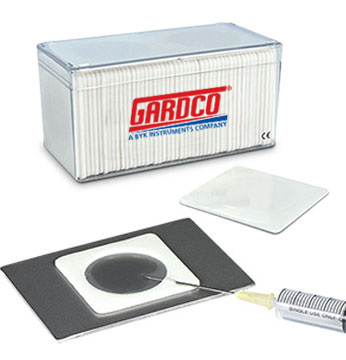
Economy Bresle Patches
Art. No.: 10875
Bresle Patches Standard High Adhesion
The Bresle Test will measure water-soluble salts and corrosion products on blast-cleaned steel. Those compounds are almost colorless and are localized at the lowest point of the rust pits. If they aren't removed prior to painting, chemical reactions can result in blister formation and accumulations of rust that destroy the adhesion between the substrate and the applied protective coating.
Select your Model
Enter a value between 1 and 100000000 in increments of 1.
excl. taxes & shipping cost
- The Bresle Patches are latex and chloride free
- They have an elastomer that the syringe does not pierce and comply with ISO 8502-6 and 8502-9.
- The elastomer on the Bresle Patch is not latex or polyurethane. It is a specific material manufactured for the Bresle Patch. We do not use latex due to latex being chloride containing material and polyurethane is not a strong enough material to stop the syringe piercing the elastomer when carrying out the injection-sucking cycles as per ISO 8502-9 section 6.
- When high adhesion strength Patches are required for testing on very corroded or coarse-grade blasted steel, use the Bresle Patches Plus as an alternative to the Standard Bresle Patches.
| Technical Data Chart | |||||||||||
|---|---|---|---|---|---|---|---|---|---|---|---|
| Data |
| ||||||||||
Economy Bresle patches Plus (High Adhesion) come in pack of 35
Manuals
- Bresle-Patches-Manual.pdf
Bresle-Patches-Manual.pdf

10ml Syringe 21Ga 1.5" Needle 20/pk
Article No: 10848

Rectangular Bottle 500ml Distilled Water
Article No: 10849

Disposable PP Beaker 30ml Graduated
Article No: 10850

Hypodermic Needle, 10/pk
Article No: 10883

EC500 Cond/pH/TDS Meter
Article No: 15336
