

Density Measurement

For Density Measurement, Precision is Key
Density is a measure of the mass to volume or weight to volume ratio of a material. This is an important property for systems that relate weight to volume for mixing or dispensing purposes. Volume measurements using traditional methods such as measuring cups or spoons, or even measuring pipettes, are imprecise. Knowing the density of a liquid or coating allows us to instead measure out precise volumes by weight or mass using a high-resolution scale. To do this, the density of the material must be known. The question is, how can we precisely measure the volume of a material to calculate its density in the first place? The answer is density cups.
Precise Volumes
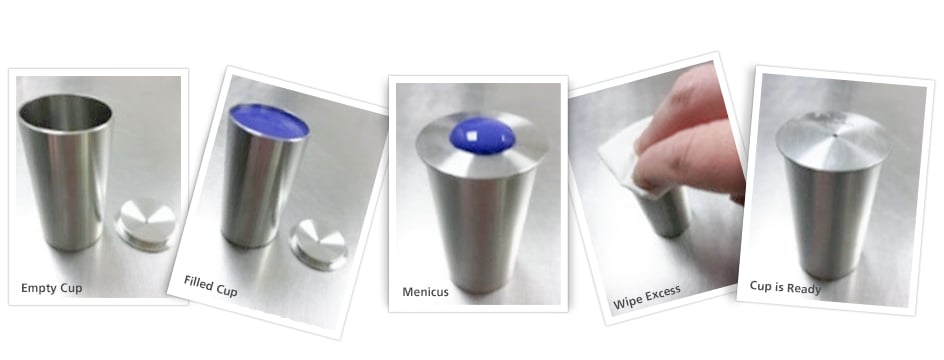
Density cups are manufactured to a very precise volume. By filling this container to that precise volume and then weighing it, we can calculate the density of any liquid. One of the major problems with filling a container to a precise volume is the meniscus. Liquids tend to be cohesive, meaning the individual molecules attract each other. Therefore, when we fill a container to the very, very top, we can often see a small mound of liquid that extends above the rim of the container. This is called the meniscus:
How to Use a Density Cup
The meniscus means that the volume of the liquid in the container is slightly larger than the volume of the container itself. To solve this, density cups have a precisely fitted lid with a small hole in the center and a rim that extends slightly into the cup. The cup is filled with more liquid than is needed, and when the lid is placed on top the excess material will flow out of the hole. Wipe away the excess and voila - the cup is filled precisely with the appropriate amount of liquid.

The meniscus means that the volume of the liquid in the container is slightly larger than the volume of the container itself. To solve this, density cups have a precisely fitted lid with a small hole in the center and a rim that extends slightly into the cup. The cup is filled with more liquid than is needed, and when the lid is placed on top the excess material will flow out of the hole. Wipe away the excess and voila - the cup is filled precisely with the appropriate amount of liquid.
Once the mass in grams is known it’s a simple calculation to arrive at the density. For US density cups, which have a volume of 83.2 ml, simply divide the mass of the liquid in grams by 10 to achieve the density in pounds per gallon (lbs/gal). US Mini Weight Per Gallon Cups have one tenth the volume (8.32 ml); with these cups the mass of the liquid in grams is exactly equal to the density in lbs/gal, and they also have the benefit of requiring less material for measurement. For imperial or ISO density cups which have a volume of either 50 or 100 ml, simply divide the mass of the liquid in grams by the volume of the cup to achieve the density in grams per ml (g/ml, or g/cm^3). Once the density of the liquid is known, any desired volume can easily be converted to a mass or weight and measured out with a scale.
| Determination of Density and Specific Gravity | |||
|---|---|---|---|
| Model | Volume (ml) | Density | Specific Gravity (relative to water) |
| U.S. Standard Cup: | 83.2 | [weight full (g) - weight empty (g)] x 0.1 = lbs/gal | [weight full (g) - weight empty (g)] x 0.01202 = specific gravity |
| U.S. Mini Cup: | 8.32 | [weight full (g) - weight empty (g)] = lbs/gal | [weight full (g) - weight empty (g)] x 0.1202 = specific gravity |
| ISO Cup: | 100 or 50 | [weight full (g) - weight empty (g)] / volume (ml) = g/cm3 | specific gravity = density |
| British Imperial Cup: | 100 | [weight full (g) - weight empty (g)] / volume (ml) = g/cm3 | specific gravity = density |
| 1 ml = 1 cm3; 1 liter = 1000 ml;
specific gravity of
water = 1 g/ml 1000 ml = 0.2646 U.S. gallon; 1 U.S. gallon = 3.785 liter | |||
Cup Factor
Comparative results on different materials measured in the same cup are accurate to within the limits of accuracy of the balances used. Comparative results between cups may be somewhat improved by determining a cup factor as follows: Divide 83.205 by gram weight of water at 25°C (77°F). Example: if the cup actually holds only 83.000 grams, divide 83.205 by 83.000 which equals 1.0025. Multiply all cup readings by this factor of 1.0025. In the same manner if the cup holds 83.400 (grams) divide 83.205 by 83.400 which equals 0.9977. Multiply all readings by this factor of 0.9977.
Care of Cups
There are numerous grades of Stainless Steel and all of them will corrode under adverse environmental conditions. A common type of Stainless Steel is the 300 Series which is most usually produced in sheets for forming into vats, kettles and the like. This series is highly resistant to corrosion under normal use conditions. It is very difficult, however, to machine this type where close tolerance and smoothness of finish are requirements. Prior to the middle of 1989, GARDCO weight per gallon cups were fabricated, using Series 300 Stainless Steel for the sidewall and the more easily machined, but less corrosion resistant, Series 400 Stainless Steel for the base and cover. Since then, with the installation of state-of-the-art computer-controlled metal cutting machinery, all GARDCO weight per gallon cups are machined from Series 300 Stainless Steel solid bar stock. With the exception of a daily cleaning, GARDCO weight per gallon cups are essentially maintenance free. If it is expected that a cup will be stored for an extended period of time, it is recommended that it be given a light coating of protective oil. With only these precautions, the cup should provide long and satisfactory service and retain its original attractive appearance.
Click the video link to watch a demonstration of how to use the GARDCO Weight Per Gallon Cups for density testing.
You can also visit our Density Testing page to view our full offering of products used to test the density of multiple mediums.
