

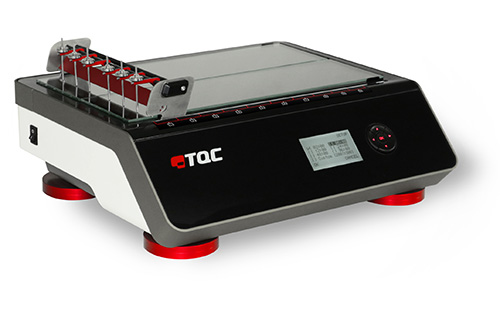
TQC Drying Time Recorder
The TQC Drying Time Recorder is a fully digitally controlled machine that conforms to the BK (Beck Koller) method and meets ASTM D5895, ISO 9117-4 and DIN EN 14022.
Select your Model
- Clear, heated digital display with intuitive Triple I interface allows easy definition of final results and checking of intermediate stages, even at low temperatures
- Digitally controlled and highly flexible, with adjustable travel and drying time ranges from 1 minute up to 200 hours, suitable for both fast- and slow-drying coatings
- Wide operating temperature range from −20 °C to +70 °C (non-condensing), enabling use in climate chambers
- Very high accuracy of < 1% of the set time
- Lubricant-free drive system eliminates the risk of lubricant thickening at low temperatures
- Hardened glass front panel protects the display and makes cleaning easy
- Compact six-track design supplied with two robust, reusable 100 × 350 × 3 mm glass beds; optional narrow glass beds available with special adapters
- Powered by a safe 24 V DC power supply
Care and Maintenance - Although robust in design, the instrument is sensitive and must be handled with care. Never drop or knock it over, and always operate it within the specified environmental conditions. For accurate and reproducible results, avoid direct sunlight and strong overhead lighting during operation. Relative humidity can affect performance, so the instrument should not be used or stored in high-humidity environments to prevent corrosion. Always connect the instrument to a properly grounded mains outlet to ensure safe operation.
Maintenance, inspection, and cleaning are essential for reliable performance. These activities must be carried out at the appropriate intervals, and all operating personnel should be informed before any maintenance or repair work begins. Always power off the instrument and disconnect it from the mains before adjusting any electrical components. Do not open the instrument or touch internal electronics unless you are ESD secured; in the event of a malfunction, consult the manufacturer. Components such as the drying time recorder are subject to natural wear and should be inspected periodically. Keep the instrument as clean as possible, especially since paint spills may occur during use, and always clean it thoroughly afterward using a suitable, non-aggressive solvent. Never use MEK, acetone, abrasive tools, or mechanical cleaning methods, as these can permanently damage the instrument. Wear gloves during cleaning, avoid excessive solvent use, and ensure all cleaning materials are used and disposed of correctly.
| ASTM | D5895 |
|---|---|
| DIN EN | 14022 |
| ISO | 9117-4 |
Manuals
- TQC-Drying-Time-Recorder-Manual.pdf
TQC-Drying-Time-Recorder-Manual.pdf
