
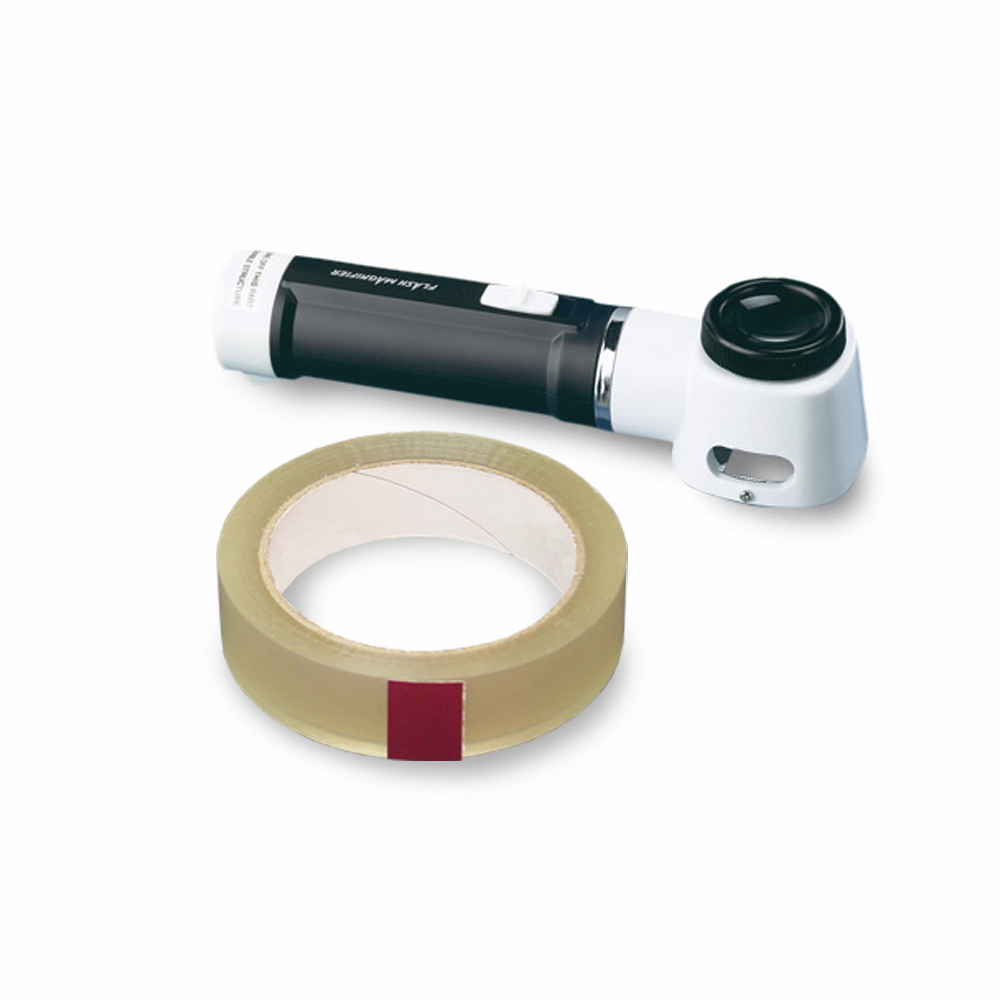
Assessment of Surface Cleanliness
Art. No.: 12704
Cleanliness Test Tape 1" X 72 Yds
The Assessment of Surface Cleanliness is a dust on steel assessment equipment & test for cleanliness. It meets ISO 8502-3. Dust on blast cleaned steel surfaces may reduce the adhesion of applied coatings and by absorbing moisture, it may promote the corrosion of the blast cleaned steel.
Select your Model
- The Adhesive Tape is a virtually colorless, transparent, self-adhesive, pressure sensitive tape with adhesion strength of at least 190 N/m.
- The hand lens capable of magnification x 10
- The Cleanliness Tape Roller helps apply the tape with even pressure
| Technical Data Chart | |||||||||||||||||||
|---|---|---|---|---|---|---|---|---|---|---|---|---|---|---|---|---|---|---|---|
| Data |
| ||||||||||||||||||
| ISO | 8502-3 |
|---|
Cleanliness Test Tape 1" X 72 Yds
- First discard the first three turns of tape from the roll.
- Remove a piece about 8" long.
- Touching the adhesive side only at the ends, press about 6" of freshly exposed tape firmly into surface to be tested.
- Press by placing the thumb across one end of the tape and moving the thumb along the tape at a constant speed and pressure. Do this three times in each direction making each stroke take approximately 5 to 6 seconds.
- NOTE: While a test procedure in which pressure is applied to a tape using the thumb is subjective, it is usually adequate, especially for use in situations where surfaces free from dust are required. In disputed cases, except when a rust grade C or D is involved, pressure may be applied to the back of the adhesive tape using a spring-loaded roller. Please refer to ISO F502.
- Remove the tape from the test surface.
- Display results on an appropriate contrasting background card, tile or paper by rubbing with thumb to adhere.
- Determine the QUANTITY OF DUST on the tape by comparing visually an area of the tape equal to an area of reference shown in FIGURE 1 below.
- Determine the predominant DUST PARTICLE SIZE on the tape by referencing TABLE 1, which defines six dust particle size classes, designated 0, 1, 2, 3, 4 and 5.
- Complete a significant number of tests to properly identify the characteristic of the surface tested. Complete at least three separate tests for each surface of a particular type of aspect. Complete at least two additional tests for each result that has a one or less quantity rating.
- NOTE: Please refer to the ISO 8502-3 Standard for the exact procedure
