 |
| Gardco/Fisher Viscosity Cups |
 |
|
| Gardco/Fisher Cup Advantages |

|
- The orifices are of the readily replaceable type permitting coverage of the complete viscosity range with one cup and interchangeable orifices. The orifice may be readily replaced if damaged rather than requiring replacement of the entire cup.
- The Gardco/Fisher Cups are produced with removable orifices of the GARDCO “snap in, snap out” type.
Cup and orifice production tolerance permits replacement or interchange of
orifice sizes without loss of acceptable cup accuracy. (Except when certified)
- Conversion formulas and table relating efflux time in seconds, to the nearest tenth of a second, to viscosity in centistokes are furnished with each Gardco/Fisher viscosity cup.
|
 |
| Introducing the standard version of the original Fisher Dip type cup with all the advantages associated with a precision laboratory stand cup. |
|
| Fisher Dip Type Cup |
Fisher Standard Cup |
- Calibration of the new Gardco/Fisher cup is traceable to the National Institute of Standards and Technology.
- Qualifies for certification under ANSI/NCSL Z540-1 or MIL-STD-45662A as applicable. Conforms to ISO 9000 when ordered with calibration certification.
- Gardco/Fisher cups are machined from solid bar stainless steel with brass, readily removable orifices. The support rods are stainless steel.
- The cup support rods are offset from the side of the cup and secured to the cup sidewall below the cup rim. This eliminates errors due to test material drainage from support surfaces.
- Gardco/Fisher cups are not matched by any other such cups, either with respect to the advantages listed above, in highest quality of workmanship and in continuing quality control procedures.
- Separation of the support rods from the cup by 18% and securing the rods to the cup below the cup rim provides best possible conditions for cleaning.
- Gardco/Fisher calibrated viscosity cups are designed, manufactured, calibrated and sold only by the Paul N. Gardner Company.
|
|
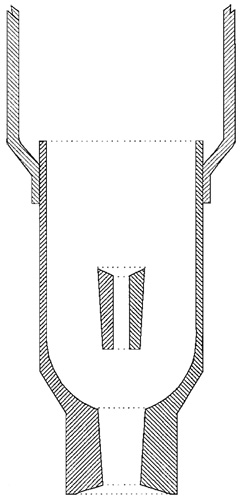
The body of the cup is machined from solid bar stock stainless steel. Note the conical opening for the orifice which permits gentle “tapping in” or “tapping out” of the orifice. Also note that the cup shape insures that materials draining from the exterior of the cup flow away from the orifice.
Stainless steel rods supporting the cup are formed so that they are held a distance away from the cup. The pad formed at the end of the support rod is welded to the cup below the cup rim. This design prevents any test material from the rod flowing to the inside of the cup. The increased separation of the two support rods also makes it easier to clean the cup.
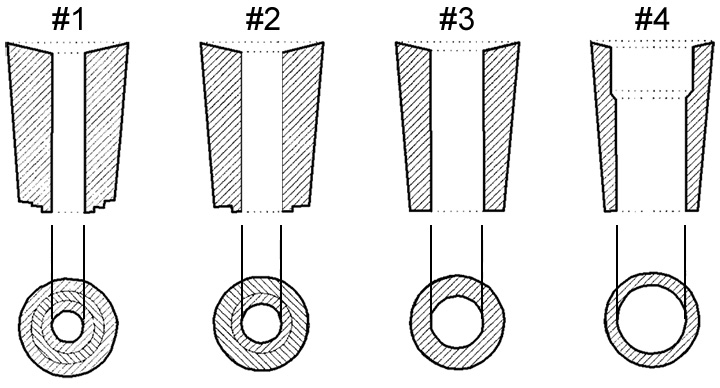
The orifices for the cup are machined from brass with the exact conical exterior to match the opening in the base of the cup. Positive orifice identification is assisted by “steps” at the base of the orifice.
|
 |
| Dip Cup Instructions For Use |
Use of the Gardco/Fisher dip viscosity cups is as follows:
|
| |
- Select the proper cup/orifice combination to be used from the Specification Table (Fig. 1), which is dependent on the expected viscosity range of the material to be measured.
- Insure that the cup is clean and that there is no residual dried material in or around the orifice.
- Adjust the temperature, if necessary, of the test material.
- Completely immerse the cup into the material to be measured in a location free from bubbles or foam, holding the cup vertically.
- Measure and record the temperature of the material that is encompassed by the cup.
- Hold cup vertically by inserting index finger into handle ring. In a quick, steady motion, lift the cup out of the sample material, starting the timer when the top edge of the cup breaks the surface. During the flow time, hold the cup no more than 6” above the level of the sample material.
- Stop the timer when the first definite break in the stream at the base of the cup is observed.
- Record cup type and number, cup efflux time in seconds and temperature. (Example: Gardco/Fisher Cup #2, 35.0 seconds at 25.1°C.)
- Promptly clean the cup unless it will be used immediately for a rerun of the same material.
|
 |
|
The body of the cup is machined from solid bar stock stainless steel. Note the conical opening for the orifice which permits gentle “tapping in” or “tapping out” of the orifice.
The orifices for the cup are machined from brass with the exact conical exterior to match the opening in the base of the cup. Positive orifice identification is assisted by “steps” at the base of the orifice. |
| Standard Cup Instructions For Use |
It is helpful and results will be more consistent if all viscosity determinations are made in a room that is free from drafts or quick temperature change and is within ±3° C ( ±5° F ) of the viscosity measuring temperature of 25° C. |
| |
- Adjust the sample to measuring temperature, usually 25°C (77°F)
- Select the cup that will provide readings which are well within the cup range.
- Make sure that the cup is clean and place it in its support.
- Make sure that the cup is level.
- Place a finger under the cup orifice and fill the cup with bubble free test material. The cup is full when the meniscus disappears where the liquid joins the sidewall of the cup. If the cup is over-filled, scrape the excess into the cup well with a spatula or by passing the cover plate across the top of the cup. Note: that the finger can be removed from the orifice when the cover plate is in place.
- Start a timer as the cover plate is removed from the cup.
- Determine the temperature of the efflux stream. If there is a significant change during the test it should be repeated.
- Stop the timer at the first break in the efflux stream, one or two inches below the orifice.
- Record the cup type and number, measured temperature and efflux time. For best accuracy, average three or more readings.
- Promptly clean the cup giving special care to the orifice.
|
| Temperature For Both Cups |
Most materials change in viscosity as a function of temperature. Those normally measured by viscosity cups change in the range of 3% to 8% per degree Celsius change in temperature. Usually, the higher the viscosity the greater the change. For acceptable accuracy, it is necessary to measure temperature at the same time that viscosity cup readings are taken. When many determinations are to be made on similar products in the same viscosity range, it may be helpful to produce a graph for converting measured temperature and viscosity cup efflux time in seconds to seconds at a specified temperature, normally 25° Celsius.
There are three variables to consider: viscosity, efflux time seconds and temperature. All three can be shown on a graph with a family of curves as shown in the following example. Viscosity level is indicated by the diagonal lines, increasing from the lower left to the upper right. Such a graph can be prepared for a given material by taking readings with the Gardco/Fisher cup over a limited temperature range as shown in the example. Within this limited range the plots of the obtained data will normally result in a straight line such as the heavy diagonal line. Draw parallel lines to the line of experimental data, as shown, representing different viscosity levels. Enter on the graph the material represented and the Gardco/Fisher cup number designation. |
| |
 |
|
Use the prepared graph by plotting on it measured temperature and efflux time in seconds. At "A" in the example these values are 26.0°C and 39.5 seconds. Read parallel to the diagonal lines to the intersection with the heavy vertical line which is 25.0°C, the target temperature. Then, reading horizontally to the left, it is found that the correct efflux time in seconds at 25°C is 41.5. Similarly, at "B" in the example, it is found that a reading taken at 23.5°C, when corrected to 25°C, changes from 40.5 to 37.5 seconds.
Compensating for temperature measured close to 25˚C must be done with caution. Even within the limited range of ±2.0°C the variation of viscosity with temperature may not be linear and any thinning materials used to adjust viscosity may also change the rate of this variation |
 |
The Gardco/Fisher viscosity cups are precision instruments. They are ruggedly constructed and with reasonable care will give many years of satisfactory service, requiring only thorough cleaning following each use. Particular care should be used in cleaning the orifice to avoid leaving deposits or scratches on internal surfaces.
Never strike the orifice directly when removing it from the cup. Place the dowel rod furnished with the cup against the orifice and strike the dowel with a heavy object such as a paper weight and catch the orifice Prior to inserting an orifice into the cup, insure that the exterior of the orifice and the receiving cone of the cup are clean.
It is good practice to retain one or more standard oils which can be used to periodically insure that the cup retains its initial calibration. Such oils are available from the Paul N. Gardner Company. Refer to the Specification Table (Fig. 1) for the oil recommended for use with each cup/orifice combination. |
| Gardco "G" Series Standard Oils |
Gardco produced viscosity cups are calibrated with standard "G" Series oils. Centistoke viscosity value
of these oils is traceable to the National Institute of Standards and Technology and are available from
the Paul N. Gardner Company.
Shown in the graph is the viscosity cup designation and the standard oil used for its calibration. Normally, cup calibration is at 25 degrees Celsius, shown on the graph by bold lines intersecting with the curve in the circle. This graph is included with each Gardco/Fisher Standard cup sold by Gardco. |
| |
 |
| |
Viscosity of most liquids, including the standard oils, are dependent on temperature. Efflux time in seconds for the indicated cup-oil combination from twenty (20) to twenty seven (27) degrees Celsius is shown in the graph. The cup may be checked with this graph and the indicated oil with reasonable accuracy within these limits. For best accuracy, the temperature of the standard oil should be 25 degrees Celsius. The standard oil value in centistokes is printed on the standard oil bottle label. Conversion from viscosity in centistokes to efflux time in seconds is by formula or table that defines the cup characteristics. The cup applicable formula and table are furnished with each cup sold as an additional customer service by the Paul N. Gardner Company or by licensed distributors. |
| Conversion Table Between Efflux Time In Seconds and Centistokes |
Flow characteristics of the Gardco/Fisher viscosity
cups are accurately defined by mathematical formula
relating them to the viscosity of standard oils which
are traceable to the National Institute of Standards
and Technology (NBS). The formula for each cup
in the series is shown on the cup graphs. For convenience, the formula for each cup
has been solved for each tenth of a second within
the normal cup range. Results are available in table
form as shown at the left and are furnished with each
cup. They are also available in sets of four for the
four cup series.
Use the table as follows: Assume an efflux time of
44.5 seconds. Read down the left column to the
44.0 second line and then to the right on this line
to the 0.5 column. The value at the intersection
is 33.9 centistokes. The tables may be read in
reverse to find efflux time in seconds from a known
centistoke value.
|
 |
| Note that conversion values are accurate only for those materials that do not deviate greatly from true liquids. |
The information contained herein, or that supplied by us or on our behalf in any other manner is based on data obtained by our own research CONVERSION TABLE BETWEEN EFFLUX TIME IN SECONDS AND CENTISTOKES and is considered accurate. However, NO WARRANTY IS EXPRESSED OR IMPLIED REGARDING THE ACCURACY OF THESE DATA, THE RESULTS TO BE OBTAINED FROM THE USE THEREOF.. This information is furnished upon the condition that the person receiving it shall make his own tests to determine the suitability thereof for his particular purpose. |
The Fisher series of viscosity cups as originally designed and produced, provided some advantages
over other existing dip viscosity cups. They accommodated a larger sample of the test material. The orifice was considerably longer than its diameter resulting in cup efflux time more closely proportional to viscosity. However, there were deficiencies in the design. The cup was difficult to clean. It was costly to produce and to calibrate. A damaged or enlarged orifice resulted in necessity for replacement of the entire cup.
The Gardco/Fisher viscosity cups retain the original internal cup dimensions and the same orifice length and diameter but with the following improvements: The weight of the new cup has been reduced to 44% of the weight of the original cup for easier temperature control when cup and material are not at the same temperature. The orifices are of the readily replaceable type permitting coverage of the complete viscosity range with one cup and interchangeable orifices. The orifice may be readily replaced if damaged rather than requiring replacement of the entire cup. The design of the lower portion of the cup eliminates hard to clean areas. The design directs the flow of all test material from the outside of the cup away from the efflux stream improving cup accuracy. Rod supports are designed and secured to the cup in a manner to prevent drainage to the inside of the cup and to provide easier cleaning. In addition to physical improvements, the cups are furnished with conversion formulas and a table which relates the nearest tenth of a second of total efflux time to viscosity in centistokes. This table is particularly useful in determining efflux time in seconds when viscosity in centistokes is known.
The Gardco/Fisher viscosity cups are calibrated at time of manufacture to within 2% of target efflux time. This calibration is with standard oils traceable to the National Institute of Standards and Technology. At an additional cost any cup/orifice combination is available with a CERTIFICATE OF CALIBRATION. The procedures and conditions of calibration on which the certificate is based qualify under ANSI/NCSL Z540-1 or MIL-STD-45662A, as applicable, & conforms to ISO 9000 when ordered with certification.
The Gardco/Fisher cups are produced to very close mechanical tolerance in elaborate jigs and fixtures. Such equipment not only insures that each cup is correctly produced but also that all cups are identical. All parts of the cup are of stainless steel except for the orifice and the name plate. The following table (FIG. 1) provides operating range specifications and the graphs with the included mathematical formulas define the flow characteristics for each numbered cup/ orifice combination. |
| Technical Data |
| Orifice No. |
Seconds Range |
Centistoke Range |
Midrange Sensitivity |
Calibration Oil No./
Centistokes |
| 1 |
22 - 60 |
11 - 48 |
0.9 |
G 20 / 35 |
| 2 |
14 - 60 |
19 - 136 |
2.5 |
G 35 / 68 |
| 3 |
10 - 60 |
35 - 320 |
10.3 |
G 60 / 117 |
| 4 |
10 - 60 |
167 - 1125 |
19.0 |
G 200 / 468 |
¹ Centistoke Values are Nominal - Actual Values Printed on Bottle Labels.
² Stated as Centistokes per Second of Efflux Time. |
The information contained herein, or that supplied by us or on our behalf in any other manner is based on data obtained by our own research
CONVERSION TABLE BETWEEN EFFLUX TIME IN SECONDS AND CENTISTOKES
and is considered accurate. However, NO WARRANTY IS EXPRESSED OR IMPLIED REGARDING THE ACCURACY OF THESE DATA, THE RESULTS TO BE OBTAINED FROM THE USE THEREOF, OR THAT ANY SUCH USE WILL NOT INFRINGE ANY PATENT. This information is furnished upon the condition that the person receiving it shall make his own tests to determine the suitability thereof for his particular purpose. |
The Fisher series of viscosity cups as originally designed and produced, provided some advantages
over other existing dip viscosity cups. They accommodated a larger sample of the test material. The orifice was considerably longer than its diameter resulting in cup efflux time more closely proportional to viscosity. However, there were deficiencies in the design. The cup was difficult to clean. It was costly to produce and to calibrate. A damaged or enlarged orifice resulted in necessity for replacement of the entire cup.
The Gardco/Fisher viscosity cups retain the original internal cup dimensions and the same orifice length and diameter but with the following improvements: The weight of the new cup has been reduced to 44% of the weight of the original cup for easier temperature control when cup and material are not at the same temperature. The orifices are of the readily replaceable type permitting coverage of the complete viscosity range with one cup and interchangeable orifices. The orifice may be readily replaced if damaged rather than requiring replacement of the entire cup. The design of the lower portion of the cup eliminates hard to clean areas. The design directs the flow of all test material from the outside of the cup away from the efflux stream improving cup accuracy. Rod supports are designed and secured to the cup in a manner to prevent drainage to the inside of the cup and to provide easier cleaning.
In addition to physical improvements, the cups are furnished with conversion formulas and a table which relates the nearest tenth of a second of total efflux time to viscosity in centistokes.
This table is particularly useful in determining efflux time in seconds when viscosity in centistokes is known.
The Gardco/Fisher viscosity cups are calibrated at time of manufacture to within 2% of target efflux time. This calibration is with standard oils traceable to the National Institute of Standards
and Technology. At an additional cost any cup/orifice combination is available with a CERTIFICATE OF CALIBRATION. The procedures and conditions of calibration on which the certificate is based qualify under ANSI/NCSL Z540-1 or MIL-STD-45662A, as applicable, & conforms to ISO 9000 when ordered with certification.
The Gardco/Fisher cups are produced to very close mechanical tolerance in elaborate jigs and fixtures. Such equipment not only insures that each cup is correctly produced but also that all cups are identical. All parts of the cup are of stainless steel except for the orifice and the name plate. The following table (FIG. 1) provides operating range specifications and the graphs with the included mathematical formulas define the flow characteristics for each numbered cup/ orifice combination. |
| Technical Data |
| Orifice No. |
Seconds Range |
Centistoke Range |
Midrange Sensitivity |
Calibration Oil No./Centistokes |
| 1 |
22 - 60 |
11 - 48 |
0.9 |
G 20 / 35 |
| 2 |
14 - 60 |
19 - 136 |
2.5 |
G 35 / 68 |
| 3 |
10 - 60 |
35 - 320 |
10.3 |
G 60 / 117 |
| 4 |
10 - 60 |
167 - 1125 |
19.0 |
G 200 / 468 |
¹ Centistoke Values are Nominal - Actual Values Printed on Bottle Labels.
² Stated as Centistokes per Second of Efflux Time. |
 |
 |
Prices subject to change Prices listed in US dollars for domestic shipments within US, Canada, & Mexico only Export orders require quotations - click here for a quote For more info call us 1-800-762-2478 or 954-946-9454. |
|
| Item Number |
Item |
Prices |
| Dip Cups |
| VI-5001 |
#1 Gardco/Fisher Standard Dip Cup |
$257.00 |
| VI-5001/C |
Certified #1 Gardco/Fisher Standard Dip Cup |
407.00 |
| VI-5002 |
#2 Gardco/Fisher Standard Dip Cup |
257.00 |
| VI-5002/C |
Certified #2 Gardco/Fisher Standard Dip Cup |
407.00 |
| VI-5003 |
#3 Gardco/Fisher Standard Dip Cup |
257.00 |
| VI-5003/C |
Certified #3 Gardco/Fisher Standard Dip Cup |
407.00 |
| VI-5004 |
#4 Gardco/Fisher Standard Dip Cup |
257.00 |
| VI-5004/C |
Certified #4 Gardco/Fisher Standard Dip Cup |
407.00 |
| Standard Cups |
| VI-5021 |
#1 Gardco/Fisher Standard Cup |
330.00 |
| VI-5021/C |
Certified #1 Gardco/Fisher Standard Cup |
480.00
|
| VI-5022 |
#2 Gardco/Fisher Standard Cup |
330.00 |
| VI-5022/C |
Certified #2 Gardco/Fisher Standard Cup |
480.00 |
| VI-5023 |
#3 Gardco/Fisher Standard Cup |
330.00 |
| VI-5023/C |
Certified #3 Gardco/Fisher Standard Cup |
480.00 |
| VI-5024 |
#4 Gardco/Fisher Standard Cup
|
330.00 |
| VI-5024/C |
Certified #4 Gardco/Fisher Standard Cup |
480.00 |
| All Cups Can Be Certified (Instruction Manual and Grid Sets are provided with each cup) |
| VI-5011 |
#1 Gardco/Fisher Cup Orifice only |
62.00 |
| VI-5012 |
#2 Gardco/Fisher Cup Orifice only |
62.00 |
| VI-5013 |
#3 Gardco/Fisher Cup Orifice only |
62.00 |
| VI-5014 |
#4 Gardco/Fisher Cup Orifice only
|
62.00 |
| Oils |
| VI-3805 |
G 20 Certified Viscosity Standard - Pint |
83.00 |
| VI-3810 |
G 35 Certified Viscosity Standard - Pint |
83.00 |
| VI-3815 |
G 60 Certified Viscosity Standard - Pint |
83.00 |
| VI-3821 |
G 200 Certified Viscosity Standard - Pint |
83.00 |
| Certification |
| VI-5000/C |
Gardco/Fisher Cup ANSI/NCSL Z540-1 or MIL-STD-45662A, as applicable, Calibration Certification Single Cup-Orifice Combination |
150.00 |
| Accessories |
| TM-14-1/2 |
Stopwatch,7-Jewel,1/10 Seconds |
92.00 |
| TM-AX705 |
Ultimate Stopwatch, 1/100 |
32.00 |
| TH-0482 |
Thermometer, Glass, blue spirit filled, 20° to 30° C |
36.00 |
| TH-16100860 |
Thermometer, Stainless 8" Stem, 25° to 125° F |
32.74 |
| TH-16100875 |
Thermometer, Stainless 8" Stem, 0° to 50° C |
32.74 |
| VI-VCC-6 |
Viscosity Cup Equivalent Wall Chart (download here) |
FREE |
| Warning |
| Silicone fluids should not be used to calibrate viscosity cups. These materials change the interface between the cup surface and the test material and therefore change the cup calibration. The following is taken from ASTM D 445: Viscometers used for silicone fluids should be reserved for the exclusive use of such fluids. Solvent washings from these viscometers should not be used for cleaning other viscometers. |
| All prices are F.O.B. Pompano Beach and are subject to change without notice. |
 |
|
 |
|